When your friend travels abroad on vacation, or even worse, lives in some other country for a semester as an exchange student or something, they come back acting a little different. They can't pass up a chance to show you how it's done in ...whatever place they went to. Yeah, we get it, you've broadened your horizons and learned a few new things, but that doesn't make you an expert. Your friends will love to hear those stories for about a week and that's it. Besides, we've seen movies and we've read books, so your second-hand enlightenment isn't all that enlightening to the rest of us.
Alasdair Beckett-King wanted to illustrate this behavior without pointing to any particular exotic destination, so he selected Toon Town. We've all seen the movies and we've all laughed our way through them, so there's an extra layer of ridiculousness in this demonstration. -via Geeks Are Sexy

It's true that medieval peasants ate whatever was available, or whatever mama served. But physicians and thinkers of the time had their own theories of what foods were healthy. These ideas were published, and became known to professional chefs for the aristocracy, and spread to everyone else if they were responsible for a family's diet. Foods were categorized as cold or hot and wet or dry. Too much of any of these properties was not healthy, but you could change them with cooking methods. For example, fish was cold and wet, so it should be fried instead of boiled, and spiced to make it warmer. Beef was dry, so it should be boiled. Most vegetables were dry, except onions, which should be fried to make them dryer. Eggs were considered wet, but the yolks were warm and nutritious, while the whites were cold.
Beyond those categorizations, each food had its own reputation for helping or harming different body organs. And some were considered either good or bad for you depending on what sequence you placed them in a meal. Read up on which foods were best and how a cook could improve on what was available for dinner at Literary Hub. -via Strange Company
I was a big fan of Star Trek: The Original Series as a kid, and Star Trek: The Next Generation as an adult. Then I lost track of the franchise while raising children. There were several more TV series and movies, which John Farrier can tell you all about. Then something happened. For one thing, Gene Roddenberry died in 1991. But even more important, streaming TV services came about. CBS All Access debuted in 2014, and rebranded as Paramount+ in 2021. They took a note from what Disney was doing with Star Wars and used their premiere science fiction property, the Star Trek universe, to drum up new subscribers. That meant offering a lot more Star Trek content in a hurry to draw the millions of fans who had followed Star Trek for up to fifty years.
Nerdstalgic takes a look at what Paramount+ came up with for this assignment. They focus on the Paramount+ years, so you might want to check this handy franchise timeline to sort out the different series by when they were produced. Since these series are eventually made available elsewhere, it might help you to decide what Star Trek you really want to watch. -via Laughing Squid
Did your delivery driver hide your package in the recycling bin? Did your friend cancel plans by text as you were driving to the meeting point? Does your boss have meetings about meetings? These are things that can enrage you, but no one you know really wants to hear them, much less consider them important. But on the internet, there may be a million people who suffer from the same injustice. That's why the satirical US Department of Miscellaneous Grievances and Minor Affairs has the Bureau of Minor Sufferings. You can register your grievance or peruse cases to see what others are going through.

You can file your complaint free and receive a receipt acknowledging your grievance. Not that anything will be done about it. Your case will wind its way through the bureaucracy and then eventually be discarded. Still, it might make you feel better to let it all out without making your friends and family roll their eyes. You can even add your name (first name only) to another person's grievance. Or just read them to make you feel less alone in your misery. -via Nag on the Lake
Well, it looks like your plan for hiding out in the wilderness during the robot apocalypse is not as sure-fire as you thought. This metal critter will come and find you! The Unitree As2-W uses a combination of legs and wheels to conquer any terrain, whether it's inclines, rocks, mountains, water, or stairs. On flat ground, it can dance to your heart's content!
Sure, it's entertaining, but what is it really good for? This video eventually shows us that the Unitree As2-W (surely a nickname will follow soon) is good for carrying your backpack on long hikes. I could think of more possibilities, ranging from carrying disabled outdoorsmen like an extreme wheelchair to getting supplies to military units far from civilization. But looking at the robot's stats, that's not currently possible. Sure, it can hold 150 kilograms on its back, but that's only while standing still. On the move, it's limited to 16 kilograms, which isn't much more than lunch for today's mountain hike. But it looks cool dancing. -via Born in Space

In the modern world, it's rare that a victim would attend a murder trial. In fact, it's unheard of. But a medieval trial procedure called cruentation, also called bier-right or the ordeal of the bier, required that the remains of the victim be brought into the proceedings. This is the belief that a corpse would begin to bleed when it is touched by, or even just brought near, the person who killed them.
A corpse would be wheeled into the courtroom, usually in its coffin, and the accused would be ordered to touch it. If the body began to bleed from any orifice or wound, that was taken as a sign from God that he or she was guilty of the murder. Any forensic scientist will tell you that this doesn't happen because blood coagulates pretty soon after death, but fluids may still seep from a long-dead corpse. Documentation on cruentation goes back to about the year 1200, but it could be much older. And it didn't die out completely until the 19th century! Read about the gruesome practice of cruentation at Mental Floss.
(Image credit: Diebold Schilling the Younger)

In Kottayam, Kerala, India, there was grand double Catholic wedding that involved three sets of twins. Akhil K. Thomas married his bride, Magi Mary Thomas, as Nikhil K. Thomas married his bride, Maria Mary Thomas.
A double wedding is already a spectacle, but this one went further. There were two Catholic priests presiding over the wedding, Father Pezhumkattil and Father Ajo Pezhumkattil of the Kanjirappally Diocese.
NDTV tells us that the twin theme originated with the brides, who searched for twin priests for this event. This particular church is locally noted as a gathering place for twins.
-via Michael Knowles
If you had asked me yesterday what "Stayin' Alive" by The Bee Gees and Pink Floyd’s “Another Brick in the Wall, Pt.2” had in common, I would have thought a while and came up with the fact that they were both written for movies. "Stayin' Alive" was featured in the 1978 movie Saturday Night Fever, and "Another Brick in the Wall" was in the 1982 film The Wall. But no, the song was written for Pink Floyd's 1979 concept album, which later became a movie. Okay, maybe they are both good for timing your CPR.
But here comes Joshua Woo, who has convinced me that they are the same song. In this performance, he sings "Stayin' Alive" over the tune of “Another Brick in the Wall, Pt.2.” He's spot on with the guitar solo, too. maybe we can convince him to song Pink Floyd's lyrics over the disco song next. -via the Awesomer
Back in May, Starbucks Korea did a promotion called Tank Day, to celebrate their reusable tumblers they call tanks. They planned it for May the 18th. People in South Korea remember May 18th as the day their military quashed a huge protest using armored vehicles in 1980, in which hundreds and possibly thousands of people died. Oops. There was immediate backlash and protests. Sure, the promotion was designed by a marketing team in a C-suite in some other country, but you'd think that someone who works for Starbucks Korea would have pointed out the blunder ahead of time. Maybe the marketing team is not used to listening to locals.
It's far from the first time global brands ended up with egg on their faces by not taking another culture into consideration. Mercedes-Benz launched in China with the name Bensi, which in Mandarin sounds like "rush to die." We know your Swedish vacuum cleaner sucks, but is that a good thing or a bad thing in English? And will machine translations and AI ensure this will happen even more? Read about these cultural screwups and more at the Conversation.
How do you make a bike obstacle course so difficult that the best riders in the world can't do it? Red Bull seems to have cracked the code. First, you float it over water, so there's always some wiggling going on. Then you make the true course as narrow as possible. That way, if you waver, deviate, or fall, you can't just get back up because you're in the water (and so is your bike). They tested this ridiculous obstacle course with a bunch of BMX pros, with results that can be described as pratfalls. It's a good thing they had a boat ready to fish riders and bikes out of the lake.
Then they challenged renowned cyclists Danny MacAskill and Kriss Kyle. These are the guys who will try it over and over again until they succeed, no matter how exhausted they get. Or until it gets too dark to try. But can they finish it? -via Laughing Squid

When you think of a "uterine exorcism," which you most likely have never thought about before, you might come to the conclusion that it's a euphemism for abortion. It's not. The euphemism for that was “menstrual regulators,” meaning concoctions that caused an abortion. No, uterine exorcism was exactly what it sounds like.
In the days before modern medicine, anything that ailed a woman could be blamed on her uterus. It was a mysterious organ that couldn't be explained, and many learned men thought it could wander about the body and dehydrate a woman through her liver or suffocate her by invading her lungs. One treatment for a wandering uterus was to lure the organ back to the pelvis by putting honey on a woman's pelvis, while making the woman smell something awful in order to scare the uterus into returning to its proper place. If that didn't work, the last resort was to call in the priests to perform an exorcism. A 10th-century addition to a 9th-century medical manual contains an invocation for such a ritual. Read about wandering wombs and uterine exorcism at Dirty Sexy History. -via Strange Company
Many years ago, I was running a radio contest and was looking for the 9th caller. I picked up the phone, and said "KD99, you're caller six!" and the phone said, "Hello! This is Miss Cleo!" It was a robocall and I hung up, but later joked that if she were a real psychic, she would have been caller #9.
Miss Cleo was everywhere back then, especially if you ever turned a TV on. Her persona was delightful, but actually calling her could cost you big time. Simon Whistler (previously at Neatorama) explains where Miss Cleo came from, where she went, and how much money was made in her name in between.
On another note, Whistler mispronounces Tammy Faye Bakker in this video, which reminds me of Chill Dude Explains. It's common for people to mispronounce names they've never heard before, but one commenter took it as evidence that Dude might be an AI voice. Whistler is not, but is likely to be unfamiliar with Bakker. I remember the 20th century, but I looked up the pronunciation anyway. Google's AI search assistant says it's "Backer" for Tammy Faye and "Baker" for Jim. So Whistler is doing his research, but relying on AI for accurate information is a losing game.
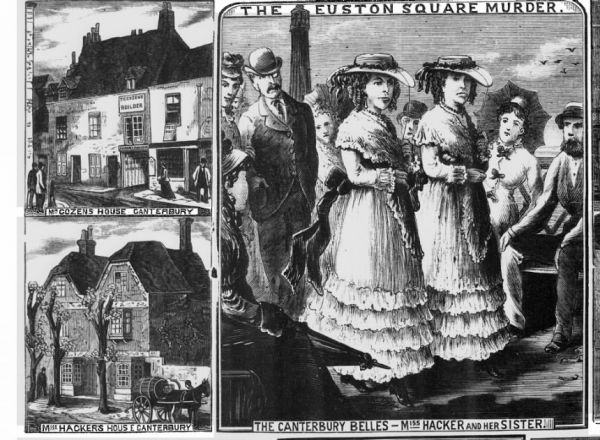
The Illustrated Police News was an early British tabloid that sold sensational crime stories with often lurid illustrations between 1842 and 1938. One has to wonder how many times they were sued for defamation in the age of not-so-meticulous fact checking.
In 1877, wealthy but miserly Matilda Hacker left her home in Canterbury due to unpaid taxes. She changed her surname to Huish and moved into a rooming house in London at Euston Square. She was only there, or, more correctly, only in her room for a couple of months before moving out, according to the maid Hannah Dobbs. Two years later, Hacker/Huish's body was found in the basement. Dobbs was arrested for murder, but the case against her was only circumstantial, so she was acquitted. But the way the case was reported in The Illustrated Police News led to a lawsuit that uncovered more than anyone involved thought possible. Read the story of the maid, the landlord, and the murder at Strange Company.
Remember when you found out that Foghorn Leghorn was a parody of a human radio character that would have been familiar to the original audiences of the 1940s? That was just one of many pop culture references in Warner Bros. cartoons that eventually lost connection with its source material because those cartoons still hold up almost 100 years later.
The one comedy impression that was used more than any other, however, came from a classic novel. So many students read Of Mice and Men in high school and said, "Wait a minute, this is a cartoon character!" Even more so if you ever eventually watched the 1939 film version starring Burgess Meredith and Lon Chaney Jr. Your cartoon experience made it hard to take the tragic story seriously. And even if you knew that, you might not be remembering the same cartoon character as the next person, because it was used so much, from 1940 up to the '60s.

Matthew Dockrey is an engineer in Seattle. He loves to build and ride bicycles, but his rides are often thwarted by the lush greenery of that region. As an engineer, he's using his head to find a solution.
Dockrey mounted an electric string trimmer on a bicycle helmet. As he rides, the trimmer cuts overhead branches (well, small ones) that obstruct his travel. He calls the task "guerilla urban landscaping."
The helmet's control mechanism is hooked into a dead man's switch mounted on the handlebars, so he must actively press a button to spin the trimmer. As you can see in this video, the setup is quite effective.
-via Hack A Day